AI Agent Access to Production Postgres Databases
Agents belong on governed analytical datasets, not live production tables.
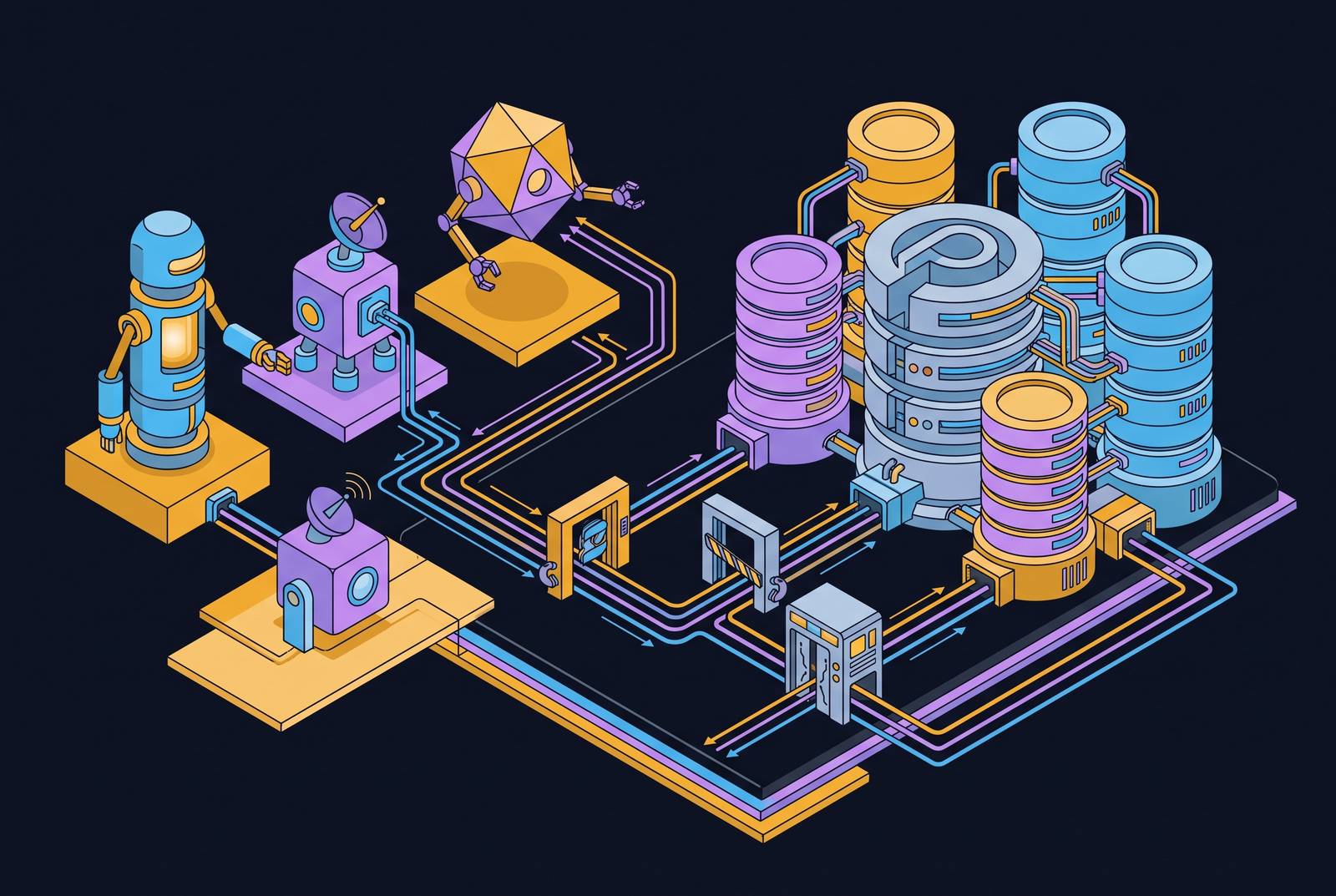
AI agents need a governed data layer as well as tighter database permissions to access production Postgres databases. For API-first and agent-first teams, a headless analytics platform provides the right architecture by exposing defined datasets through a governed API. Agents can query shaped analytical data or run unpredictable queries against mutable production tables, and that choice matters.
Why AI agents querying databases are different from humans querying databases
An AI agent can look like just another database user, with an identity, a role, and permission to run SQL. That resemblance hides a different operating pattern. Human analysts often self-limit by questioning a DELETE, noticing a missing WHERE clause, or reconsidering a large migration at 3 a.m. Agents have no comparable intuitive grasp of consequences. They execute what the model decides at the speed the database allows, and they can retry transient errors without pausing.
Traditional access controls govern authorization. Roles, permissions, and row-level security set what an identity is allowed to do. They do not establish whether a permitted query is safe against the current data volume, at that moment, or after the queries that preceded it. The problem begins where authorized behavior meets a production system with finite capacity and mutable state.
LLM non-determinism makes that boundary harder to manage. The same natural-language prompt can generate different SQL on different invocations, including destructive queries where write permissions allow them. The next invocation remains unpredictable after a successful one because of an architectural mismatch beyond what asking the agent to exercise more care can resolve.
The specific ways agents damage production databases that access controls alone cannot prevent
Authorized access can degrade, corrupt, or destabilize production. Lock contention and query pile-up can cause this kind of harm. A long-running analytical query on a live OLTP table can hold locks that block writes, leading to timeouts and user-facing outages. The database may have allowed every operation under its rules. Permission to read a table does not establish that an analytical workload belongs on it.
Accidental mutation is another risk when agents need write access to log results, update state, or close feedback loops. A model-generated UPDATE or DELETE with an incorrect predicate can change the wrong production rows. Schema inference can fail even without a write. An agent may misread a column name, join on the wrong key, or mishandle soft-deleted data while giving an answer that sounds confident. Because the SQL can run without a database error, the semantic mistake may go unseen.
Volume amplification can put a strain on the database as requests add up. An agent processing a queue, iterating, or retrying can issue thousands of queries per minute against a table that a human would query once. Connection pool exhaustion can follow from that repeated access. The damaging unit is therefore not always a single query. It can be the sequence and rate of otherwise permitted requests.
Broad read access also gives agents a way to carry out data exfiltration. Prompt injection in user-supplied data can, in principle, lead an agent to return sensitive rows it was never meant to show. In a tool chain, the consequences of a bad result extend beyond the data agent itself. One agent’s output becomes another’s input, so an incorrect result can poison downstream decisions. These failures concern workload, meaning, and disclosure as well as database integrity.
Why the standard mitigations teams reach for first are insufficient
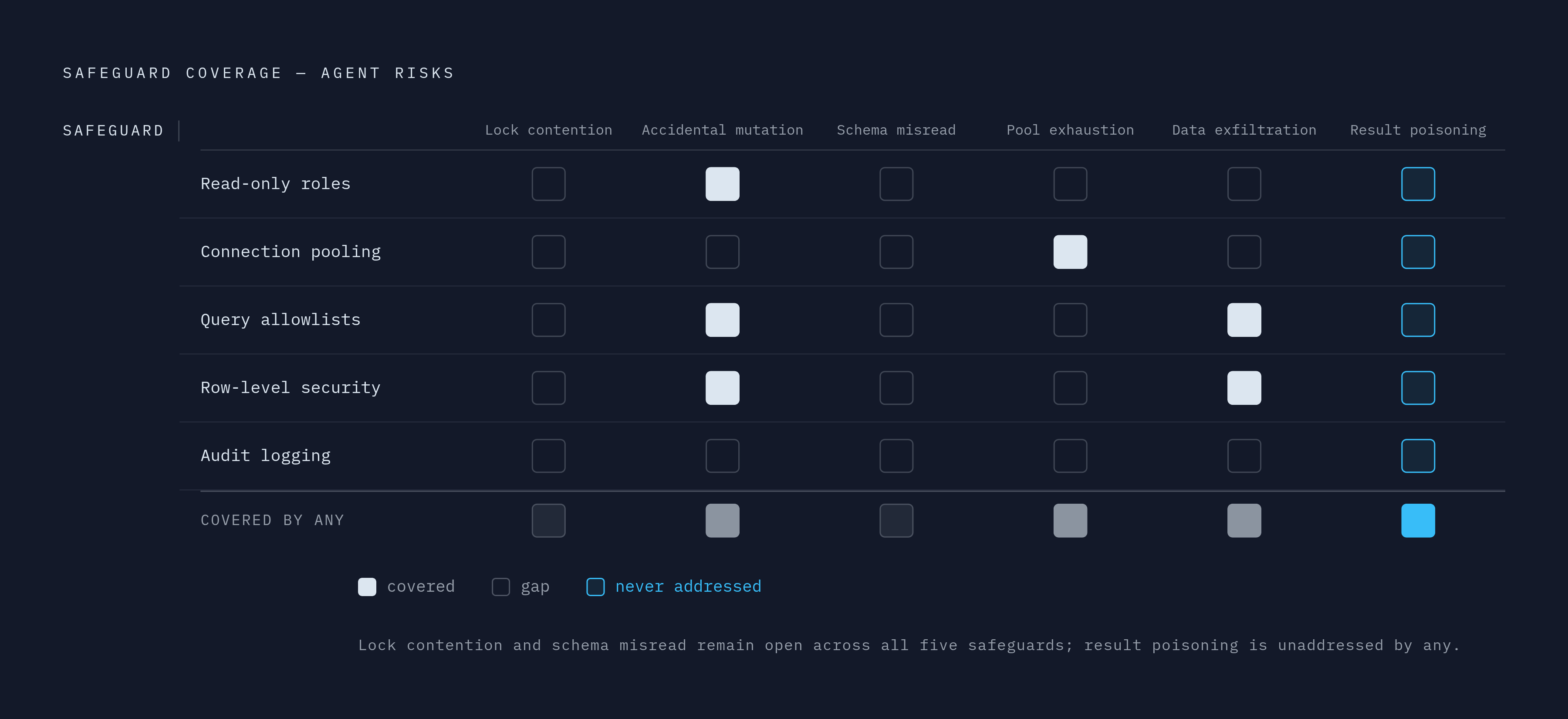
Read-only roles are a reasonable first safeguard because they remove the agent’s ability to mutate production data. They do not, however, remove the cost of reads or make their results correct. Lock contention, volume amplification, schema misreading, and prompt-injection exfiltration remain possible. Read-only access also cannot support a workflow whose purpose includes write-back.
Connection pooling addresses another real constraint. PgBouncer and Supavisor manage database connections and can reduce connection exhaustion. Neither function establishes a query’s cost, breadth, or semantic correctness. A pool can manage how requests reach Postgres without making those requests appropriate for production. Connection management is useful infrastructure, but it is not query governance.
Query allowlists and parameterized templates offer stronger control when the work consists of narrow, known questions. Their limit appears when the agent’s value depends on generating novel queries from natural language. Row-level security solves a different problem by providing strong multi-tenant data isolation. It does not determine what an agent can aggregate, infer, or disclose across rows it is legitimately allowed to see.
Audit logging provides a record. It can expose damage after the fact, while high-volume agent workloads can make the logs themselves unmanageable. Stacking these safeguards is sensible, but their coverage does not become complete simply because several are present. Each governs a different part of direct database access, while the agent still operates against production tables. Where the query runs and how much meaning the agent must reconstruct before running it remain unresolved.
What a governed data layer between agents and production actually does
A governed data layer changes the object of access. Instead of allowing an agent to explore raw production tables under tighter permissions, it exposes pre-modeled, pre-calculated datasets through a defined interface. Those datasets contain the metrics, aggregates, and analytical outputs the agent actually needs. The layer is therefore more than a filter placed in front of a database connection. It replaces the live production query surface with a materialized analytical one.
In this architecture, agents query shaped Parquet datasets through DuckDB or an equivalent query engine. Keeping production Postgres separate from that query path protects its tables, connection pool, and state from locking, exhaustion, or accidental mutation by those analytical requests. The isolation comes from separation. An agent may still formulate a new analytical query against the exposed dataset.
Pre-modeling also moves responsibility for meaning out of the agent’s runtime reasoning. A metric such as “monthly recurring revenue” is defined and calculated by a human rather than reconstructed from raw subscription rows on every invocation. The agent consumes that definition instead of guessing which joins and columns express it. This does not make every interpretation an agent produces correct.
Governance then has a concrete place to operate. The data layer defines which datasets exist, which columns they expose, and what an agent is allowed to ask. An MCP server can provide a structured, auditable interface in which requests follow a defined contract rather than pass through an open production database connection. Sensitive data still requires deliberate exposure rules. Those rules apply to the shaped datasets in one place instead of being spread across role definitions and runtime prompts.
The headless CMS analogy makes the separation clear. Content can be managed apart from any one consumer interface and sent through a governed API. Every front-end does not need direct access to the production CMS database to use that content. In the same way, agents and human analytical interfaces can consume shared datasets without reaching into production Postgres. The API becomes the contract between the data and its consumers, while the choice of consumer remains open.
For a headless analytics platform, this separation is the substantive requirement. API control alone is not enough if the API merely forwards unpredictable work to production. The platform must provide both an interface independent of a dashboard and a governed analytical surface behind that interface. These are distinct criteria, and both matter to agent-first teams. One permits different tools to use the data, while the other gives those tools a consistent and isolated basis for their work.
How can Supabase teams add governed agent analytics without a warehouse or a data team
Supabase teams already have Postgres as their starting point, with row-level security, real-time, and storage in the same foundation. A governed analytics layer can extend that foundation without requiring a separate warehouse, schema migration, or ETL pipelines. The architectural goal is to separate analytical consumption from the database’s production responsibilities. That makes the pattern relevant to teams that need agent access but do not have a data engineer to operate another system.
Implementation begins with the outputs the business needs, including cohort retention, revenue by plan, and active users by segment. These outputs are modeled datasets. They are then materialized as governed Parquet datasets for agents and human dashboards to query through DuckDB. A single MCP server exposes the layer to different agents, tools, and workflows.
Dreambase implements this pattern by extending Supabase and Postgres into a headless analytics platform for human teammates and AI agents. It connects to a Supabase or Postgres project, as well as other sources, and exposes the governed layer through a single MCP server. The layer needs the former to prepare analytical datasets. Agents need only the resulting governed surface.
For a team adding usage analytics to an AI agent without a prebuilt dashboard UI, the same architecture keeps the interface separate from the calculations. An agent can consume defined usage datasets through the governed interface rather than depend on a dashboard to provide analytical context. Human dashboards can use those definitions too. In an implementation such as Dreambase, the shared layer serves both audiences rather than creating a separate analytical model for each. The absence of a required dashboard does not mean the absence of a data contract.
The distinction also clarifies what “raw API access” should mean for a Supabase buyer. Access to an analytical interface need not mean unrestricted access to raw production tables. The useful criteria are control over the consumer interface, shared metric definitions, isolation from production query load, and a structured agent interface. A dataset-based implementation using Parquet, DuckDB, and MCP supplies that pattern, while Dreambase provides an implementation built for this Supabase context.
Metrics can be calculated once and pushed to dashboards, Slack, or the inbox rather than recalculated independently whenever a person or agent asks. The same governed layer can also provide board-ready metrics and automated reports. For a founding team without a data engineer, that means the infrastructure serves human reporting as well as agent access. Both uses depend on the same benefit, which is a shared definition of what the numbers mean.
The principle that should govern agent data access going forward
Before connecting an agent to data, the governing decision is whether it will receive raw access or governed access. Production permissions remain necessary controls, but they are not a substitute for choosing the right query surface. Each agent is another stakeholder in the team’s data and should consume metrics with a single, human-auditable definition. Reconstructing those metrics from raw tables on every invocation invites disagreement between agents and the people relying on them.
For Supabase builders, the foundation and tooling for this separation already exist, while each additional agent increases the importance of getting the boundary right. The decision is whether an agent’s freedom operates over mutable production tables or defined analytical datasets.
Sources
- Parallax: Why AI Agents That Think Must Never Act
- The Irreversibility Budget: Fleet-Level Risk Accounting and Admission Control for Agent Operating Systems
- AI Agent Data Access: Governed Patterns and Setup [2026]
- AI Agent Governance: Enterprise Two-Layer Framework Guide
- Agentic Transaction: Towards ACID-Compliant Agent Systems
- SNARE: Adaptive Scenario Synthesis for Eliciting Overeager Behavior in Coding Agents
- aiAuthZ: Off-Host, Identity-Bound Authorization for AI Agents
- What Is a Semantic Layer for AI Agents? A Complete 2026 Guide