Prompt Injection Risks in Agent-to-Database Pipelines
Agents with live database access widen both injection and damage.
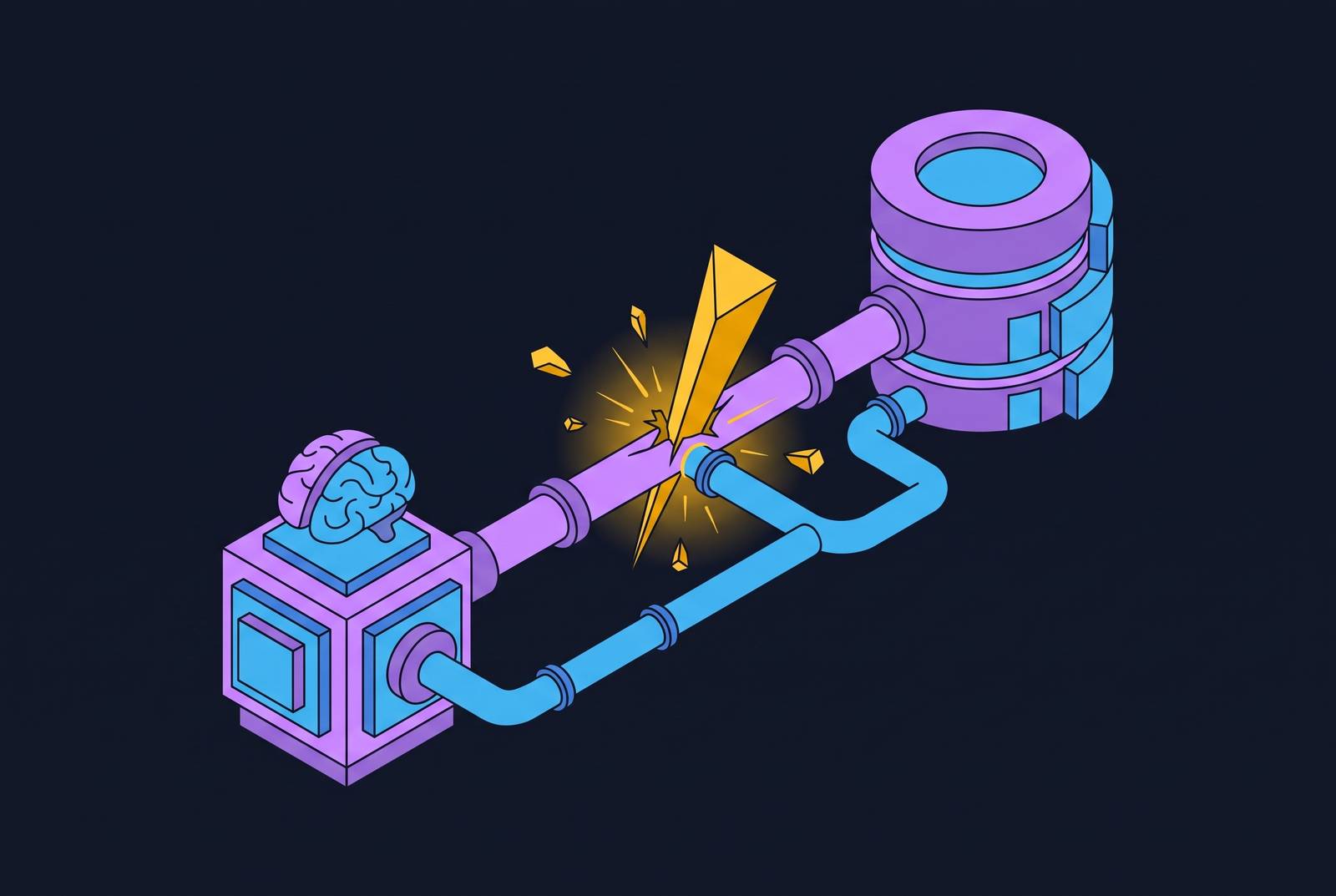
Prompt injection risks in agent-to-database pipelines depend on both architecture and model behavior. For API-first and agent-first teams choosing a headless analytics platform, the critical distinction is whether agents query production databases or consume governed, read-only datasets. Dreambase implements the latter pattern for Supabase teams, reducing exposure to raw data while removing production write access from the analytics path.
Why prompt injection in agentic pipelines is an architectural problem, not just a model one
SQL injection is a useful starting analogy because both attacks work when a system fails to keep trusted instructions separate from untrusted data. Parameterized queries establish that separation syntactically at the database layer. Language models have no such built-in way to ensure that input text stays data and never becomes an instruction. Better model behavior can reduce the chance of following a malicious payload, but it cannot provide the same boundary as a deterministic parser. Engineers must therefore ask what the surrounding system permits when that distinction fails.
That question became more consequential when stateless chatbots gave way to agents with tools. An injection that once produced an embarrassing answer can now cause a database write or an external API call. OWASP named prompt injection LLM01:2025 and ranked it first in its Top 10 for Large Language Model Applications. Its importance is not confined to the content of a response. The same reasoning failure has different consequences depending on the authority attached to the agent.
Strong model alignment and Row Level Security help, but neither keeps instructions separate from data. Alignment concerns how the model behaves, while Row Level Security limits which database rows an identity can access. An agent can still misuse access that a policy legitimately grants. Architecture sets what an agent can reach and do before the model’s behavior decides whether an attack succeeds.
How agentic architectures expand the attack surface that injection can reach
An agent’s exposure grows with every tool, data source, and memory file it can read or write. Direct injection needs control over input sent straight to the model, but indirect injection can come through ordinary retrieval. An attacker can place a payload in a database record, document, or email that the agent encounters while completing an authorized task. The attacker does not need to become the user issuing the request. The retrieval path itself carries the attack across the trust boundary.
That crossing can happen without an obvious command to ignore earlier instructions. The Seoul National University and UIUC ADI paper describes agent data injection, which disguises malicious data as trusted metadata. Resource identifiers, author fields, and tool-call formats can guide what an agent does without looking like instructions. Defenses that focus only on separating commands from content can therefore miss the attacker’s actual leverage. The agent may follow its intended task while acting on a false account of which resource or tool response it should trust.
Persistent memory extends that exposure beyond the retrieval that first introduces it. University of Washington research shows that payloads already planted in memory files, including CLAUDE.md, AGENTS.md, and knowledge-base documents, can attack current and future sessions. The research also distinguishes this from the harder task of making an agent overwrite its own memory through untrusted external content. Persistence is not an automatic result of every injection. But once malicious content is in trusted memory, it can compromise a later interaction without the agent retrieving the original record again.
A hijacked agent can poison shared memory, direct downstream agents, or manipulate an orchestrator’s decisions. Governed retrieval, such as the pre-calculated datasets served by Dreambase, narrows the shared data surface compared with live queries against raw application records. It does not make every separate memory file safe. The architectural benefit is a smaller, common retrieval boundary, rather than an assumption that each agent will independently recognize every malicious instruction.
Why MCP concentrates injection risk at the protocol layer
MCP standardizes connections between AI applications and external tools, APIs, databases, files, and workflows. These connections also bring tool descriptions, server metadata, and retrieved content into the model’s operating context. Each can hold content that steers how the model uses tools later. The connector between the model and database is itself part of the security boundary. Standardizing connectivity does not by itself establish which requests should be authorized.
Tool poisoning and rug-pull attacks expose that distinction through changes to tool definitions after installation. A definition that initially appears legitimate can later redirect requests or credentials to an attacker-controlled endpoint. A 2026 U.S. patent documents that an MCP process could be changed without the user or AI platform knowing, redirecting requests and accessing resources on a local machine or enterprise private network. This is a failure of the connection’s trust assumptions. The apparent continuity of a tool does not establish continuity of its behavior.
The NSA’s May 2026 security advisory identifies a related gap in the current MCP specification. It finds that the specification falls short on key security protections and lacks support for exchanging Role Based Access Control (RBAC) permissions at instantiation. As a result, access boundaries between tasks or services cannot be enforced or verified at that protocol layer. An application can set permissions elsewhere, but it cannot rely on the protocol to set them.
Supply-chain exposure further complicates the boundary because MCP servers are commonly obtained from third-party repositories without cryptographic verification. The protocol lacks standardized mechanisms for verifying server provenance or validating package integrity, while unauthorized servers and malicious packages create additional exposure. For an agent connected to a live database, these gaps sit on top of the model’s injection surface. They do not cancel out because the connection uses a standard protocol. Prompt engineering and model hardening alone cannot close gaps in authorization, provenance, or the scope of the connected resource.
Why direct database access gives agents both the attack surface and the write blast radius simultaneously
The access pattern makes these risks concrete in a production database pipeline. Every raw row an agent reads is external content and may hold an attacker-controlled payload. A poisoned record presents the same trust problem as a poisoned document, even though it arrives through an authorized database query. Its storage location does not make its contents authoritative instructions. Direct retrieval exposes the agent to whatever raw fields its queries and permissions allow it to reach.
Write permissions then turn that exposure into a threat to the source of truth. Production credentials embedded in agent configuration define which actions a hijacked agent can perform. With INSERT or UPDATE access, the agent can corrupt records as well as give a wrong answer or disclose data. Those changes can affect what later queries return to both humans and other agents. The blast radius is the permission scope of the compromised identity.
Chatty or unbounded queries consume the same connection pool and I/O budget, and a compromised agent running a table scan can degrade service while extracting data. Row Level Security on Supabase/Postgres remains a meaningful control, but misconfigured RLS can create both security and performance failures. Complex policies can be costly at scale and may not account for the query patterns an agent produces. A permitted query is not necessarily a safe workload for the production system.
Least privilege therefore concerns both what the agent can see and what it can change. GDPR’s data minimization principle under Article 5(1)(c) makes that scope a regulatory concern as well as a security concern. Unauthorized writes outside the agent’s intended role can create exposure beyond the immediate technical incident. RLS can narrow permissions, but it does not turn retrieved text into trustworthy instructions or make allowed writes harmless. When an agent has both live raw-data access and production write permissions, the same identity links the injection surface to the write blast radius.
How pre-modeled, read-only datasets shrink both vectors by design
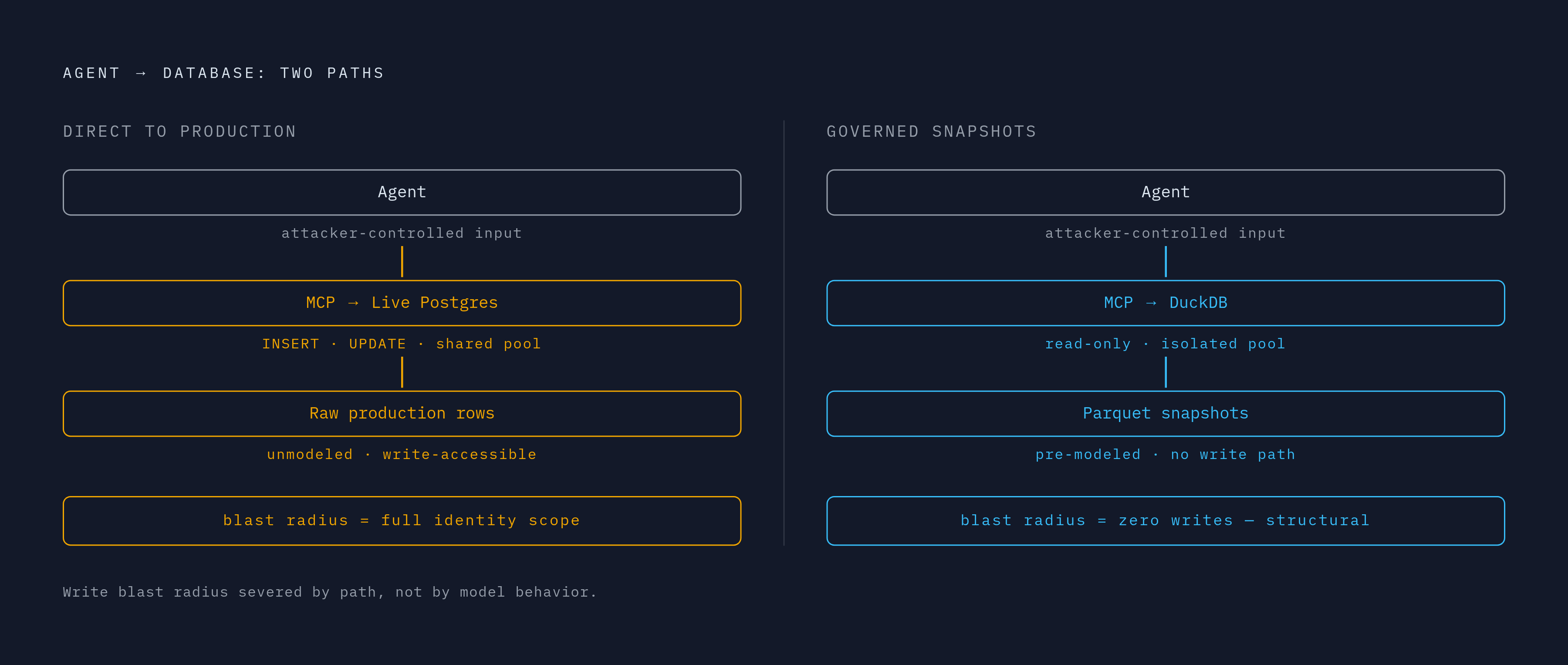
Changing the data path breaks that coupling. An agent restricted to pre-modeled, read-only datasets has no production write capability through that path, even if an injection succeeds. It also encounters only the records and fields included in the governed output, rather than every raw field available through live queries. These are structural limits that do not depend on the model refusing a malicious request.
Pre-calculation and schema validation establish that narrower surface before the agent retrieves data. A malicious payload buried in an application field cannot reach the agent through the dataset if that field is excluded from the modeled output. Approved metrics also give humans and agents the same authoritative numbers, rather than answers that vary with transaction state or concurrent writes. That reduces opportunities to manipulate reasoning through inconsistent results. Structured data is not inherently immune to injection, but explicit modeling limits which content can carry it.
The execution path matters as much as the content. Parquet datasets queryable through DuckDB let agents work against snapshots isolated from live production connections. Those queries do not compete with application requests for the production connection pool or I/O budget. Unbounded agent queries are consequently removed as a source of production database memory pressure through this path. The separation protects the application from agent query load without requiring every query to be well behaved.
A single MCP server serving governed datasets creates a narrower trust boundary than a connector to a production Postgres instance. The protocol’s RBAC gaps still matter, but they no longer sit directly in front of the same production capabilities. The data layer limits what can be read, and the absence of write access limits what a compromised agent can change. This is least privilege enforced through the available resource, rather than left entirely to a permission policy over a live database.
Dreambase implements this pattern for Supabase teams with pre-modeled governed datasets, DuckDB-queryable Parquet snapshots, and a single MCP server. Agents on this path never touch the production Postgres instance, and humans and agents use the same pre-calculated metrics. For teams evaluating a headless analytics platform for API-first and agent-first work, this access boundary is a concrete criterion beyond frontend preferences. The relevant comparison is between raw production access and a governed dataset interface. The architectural value comes from what the agent cannot reach.
What defenses still apply at the application layer, and what they cannot do
Guardrails remain necessary because isolation bounds the consequences of reasoning errors that can still occur. A centralized gateway can enforce permissions and log agent database access. Read replicas provide an alternative to querying production directly, while service accounts can restrict access to minimal permissions and approved query patterns. These controls address different parts of the path and remain useful even when datasets are governed. A replica reduces exposure to production query load, for example, but does not by itself remove malicious content from raw records.
Continuous monitoring makes those controls actionable. Teams need visibility into agent interactions with data sources to detect anomalous query patterns, unexpected writes, and exfiltration attempts. Supabase’s documentation warns of danger when committed memory is near or above the commit limit. Connection storms or large concurrent queries can trigger the OOM killer and crash Postgres, and agent-generated load is a plausible source of that pattern.
The remaining limit is that filters do not establish a complete semantic boundary. Seoul National University and UIUC’s ADI research shows how malicious metadata bypasses defenses focused on coarse-grained instruction separation. Its reported 50.0% success rate against state-of-the-art agent defenses shows why spotting explicit commands is not enough. University of Washington’s memory-injection research exposes another limit, because filtering a current query does not remove payloads already planted in persistent memory. A control must protect the surface where the attack resides.
Application controls and architectural isolation are consequently complementary. Gateways, minimal permissions, and monitoring reduce the likelihood of misuse and help detect it. Governed, read-only datasets first remove capabilities that would make successful misuse catastrophic to the production database. The foundation is restricted access, and the second line of defense is careful control over how the agent uses it.