MCP as the Analytics Access Layer for Agent-First Postgres Teams
Governed metrics, not raw tables, make MCP safe for agents.
For API-first and agent-first Postgres teams, a headless analytics platform provides metric definitions through APIs and MCP without requiring a prebuilt dashboard UI. MCP becomes a trustworthy analytics access layer only when it exposes pre-modeled, governed data. The protocol and the analytical layer beneath it must therefore be designed together, with shared definitions for humans and agents and an isolated query path that protects production.
Why raw MCP access to Postgres replicates the same risks as direct agent database access
MCP appears to solve the difficulty of connecting agents to data because it standardizes the connection between an AI application and a data source. That can make a working connection look like a governed one. The two are not the same thing. MCP defines how clients discover and call capabilities. The official MCP architecture states that the protocol focuses solely on context exchange and does not dictate how AI applications use or manage the provided context.
This distinction becomes consequential when teams connect MCP servers directly to production Postgres. The “God User” anti-pattern gives agents the permissions of a single broad-access account, and MCP does nothing to prevent that inheritance. On Supabase, queries that agents run directly can also bypass row-level security and use up connection pools. More MCP server instances cannot remove a database bottleneck. A server can implement access controls, but those controls depend on its implementation, so exposing raw tables through MCP retains the risks of raw-table access.
What MCP actually is and what its three-layer architecture does and does not provide
MCP simplifies the N×M integration problem by replacing bespoke AI-to-data connectors with a common contract. Its architecture separates three participants. The MCP Host is the AI application, such as Claude or a custom agent, while the MCP Client manages the connection inside that host. The MCP Server is the program that exposes capabilities.
The capabilities fall into three data-layer primitives. Tools are executable functions, including functions that run queries. Resources supply contextual information, such as schemas and governed datasets, while Prompts provide reusable templates for repeatable workflows. MCP uses JSON-RPC 2.0 and supports Stdio for local process communication and Streamable HTTP for remote servers, with OAuth recommended for authentication tokens.
Anthropic launched MCP in November 2024 and donated it to the Agentic AI Foundation under the Linux Foundation in December 2025. Its backing includes AWS, Google, Microsoft, OpenAI, Bloomberg, Cloudflare, Anthropic, and Block, establishing it as vendor-neutral infrastructure. The scope remains the description and invocation of capabilities. The server author decides which data to expose and what permissions, metric definitions, and audit logging to use.
How the 2026-07-28 stateless specification changes what data teams can build on MCP
The 2026-07-28 specification made MCP stateless at the protocol layer. Before that revision, protocol sessions meant teams had to keep session context across server instances, which called for shared storage and made horizontal scaling harder. Every request now includes its protocol version, client identity, and capabilities in its _meta field. Any server instance can therefore process the request without session affinity. An MCP server in front of governed analytical data can scale like a REST API behind a plain round-robin load balancer.
The same specification hardened authorization through RFC 9207 issuer validation and deprecated Dynamic Client Registration in favor of Client ID Metadata Documents. Dynamic Client Registration remains available for backward compatibility under a formal deprecation policy that sets a twelve-month minimum window for deprecated features. The revision also added an extensions framework for Tasks, MCP Apps, and Enterprise Managed Authorization.
These changes make shared analytical services easier to run. They do not govern the data those services expose or expand the capacity of the underlying database. Agents querying production Postgres can still exhaust its connection pool, regardless of how many stateless servers accept requests. The architectural opportunity is an independently scalable MCP access layer in front of a governed analytical copy.
Why the governance gap beneath MCP is the actual architectural problem for Postgres teams
The architecture lacks authoritative definitions and consistent permissions beneath the protocol. If three places in a codebase calculate “active user” differently, standardized access exposes the disagreement to more consumers more often. An agent asked for recurring revenue from raw tables must infer the business formula from table structure, so natural language-to-SQL leaves the definition to the model.
Careful tool definitions can limit which queries an agent runs, but they cannot make upstream formulas agree. A bounded query can still return the wrong metric. Governance must therefore cover both the meaning of an answer and the authority to retrieve it. Permissions that differ or give too much access become attack surface when agents can query at machine speed.
For Supabase teams, this semantic and security gap also has a direct operational cost. Row-level security friction, connection-pool limits, JSONB columns that resist clean aggregation, and analytical queries hitting OLTP compute compound the difficulty of querying production. Those demands raise costs on the Supabase bill. A server that accepts requests efficiently does not remove the cost of answering them against the wrong data layer.
What safe agent-to-Postgres access actually requires at each layer of the stack
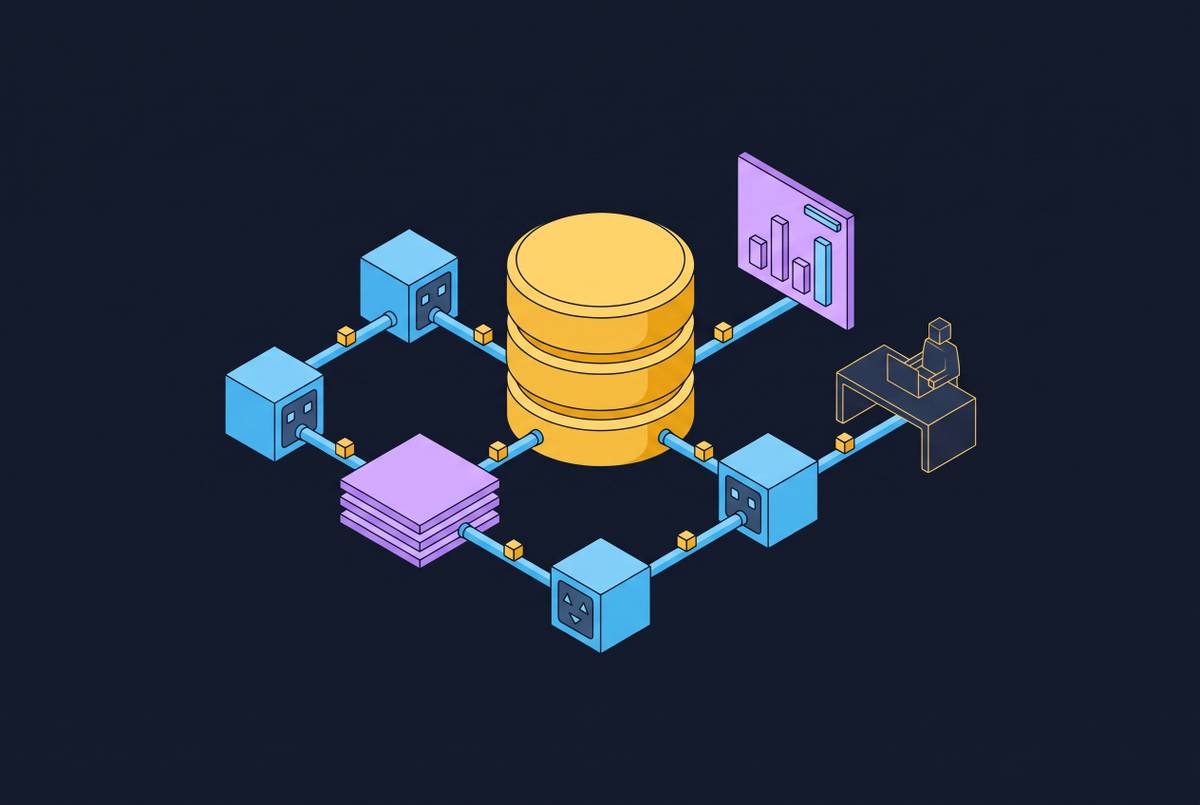
The response to that gap is to keep agents away from production and route analytical queries through a centralized access layer. That layer should enforce permissions, log every call, and send traffic to an isolated analytical copy. Direct agent database connections should be prohibited under the principle of least privilege.
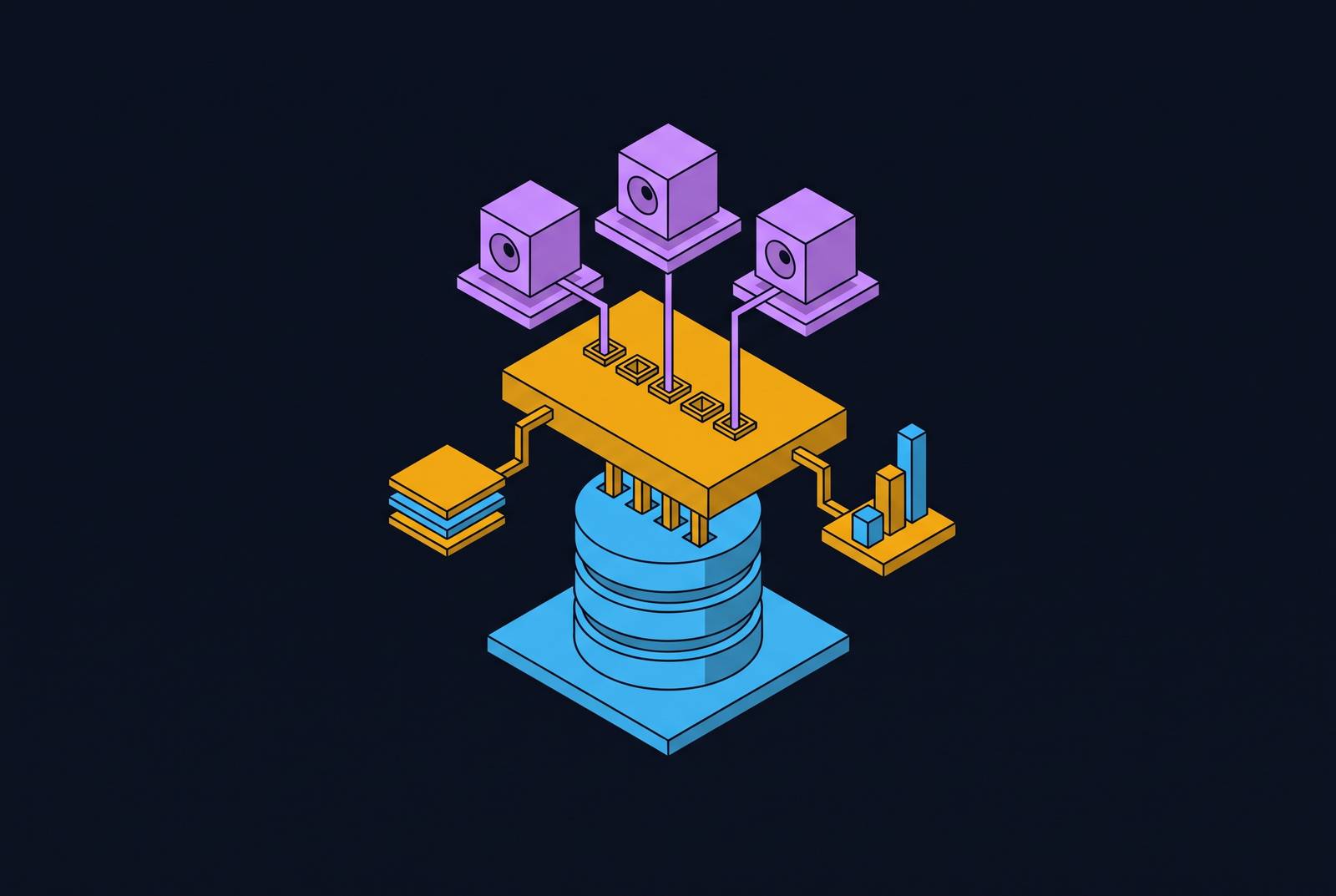
The analytical copy has pre-modeled datasets that can be queried without touching production. This isolates agent query traffic from production connection pools, while stateless MCP allows the access layer in front of the copy to scale horizontally. The semantic layer sits between the copy and the MCP server and holds the authoritative definition of each metric. Agents receive a business abstraction.
MCP Resources can expose schemas, pre-calculated metrics, and governed Parquet files that agents read without constructing queries. Tools should be used only for analytical calls that are parameterized and bounded. Traceability belongs in the same access path. A production-grade analytics server must log what query ran and which definition it used, and return a result with provenance so that both agents and humans can assess the answer.
How headless analytics provides full API control without an opinionated frontend
Headless analytics is a metric and semantic layer decoupled from any single front end and queryable through MCP or API. It defines metrics, KPIs, and business rules centrally, then exposes them to dashboards, embedded analytics, spreadsheets, agents, and operational applications. The interface does not own the definition. For teams seeking an analytics backend without a required dashboard UI, this separates the choice of presentation from the source of analytical truth.
That separation also answers how to add usage analytics to an agent without a prebuilt interface. The agent consumes governed metrics from the headless layer rather than reproducing dashboard logic or inventing SQL definitions. When Claude and a dashboard query the same definition, they receive the same answer. This follows the architectural move of headless CMS, which separates content definition and storage from rendering so different consumers can use the same source.
For Postgres teams, however, a semantic layer with an MCP wrapper is not sufficient if queries still reach production. Together, the copy and semantic layer provide isolated execution and shared meaning, while MCP exposes Resources and bounded Tools with provenance. The relevant criteria are therefore API access, front-end independence, governed definitions, and production isolation.
Why Postgres observability must be in place before agents are in the query path
Governed access establishes the intended query path, while observability shows whether that path is working as designed. Without both, a team cannot reliably distinguish a bad agent query from a bad metric definition or a legitimate performance problem. Monitoring must precede exposure to agent traffic. Baseline p50/p95 latency dashboards, query-level performance data, and connection-count monitoring give teams the operational context needed to diagnose a load spike.
In Postgres, pg_stat_statements records each query’s mean time, total time, and call count, which helps teams see what agents actually run. Active connections must also be monitored continuously relative to max_connections, because agents can push usage beyond safe limits silently. A cache hit ratio below 95%, the established threshold for hot data, shows that analytical queries are reading from disk, bypassing shared buffers. Concurrent agent traffic makes that condition more acute.
The scope must extend beyond the database to structured logging for the API layer, authentication flows, Edge Functions, and client-facing errors. Otherwise, agents can amplify failures on surfaces that database monitoring does not explain. Isolation makes these signals easier to interpret. When agent queries run against an analytical copy, a production load spike is not direct agent query traffic, which narrows the investigation.
What metrics a Supabase-backed startup should define in its governed layer before agents query them
Pre-seed and early-growth teams need a small set of metrics that stays stable and covers revenue health, growth, and cost. The starting set is MRR, churn rate, signups, activation rate, and burn rate. The team needs to agree on each definition and encode it in the governed layer before agents use it. The objective is a dependable set of answers that the team and its agents can use without interpreting raw tables independently.
Agreement has to extend to the terms those metrics depend on. Without a consistent definition of “active user,” the billing system, product analytics tool, and agent can each return a different number with no authoritative basis for choosing among them. Pre-calculation removes the need for each consumer to recompute the formula. Pushing those outputs to workplace messaging tools, email, and dashboards makes them available where people work, while agents consume the same results.
If the team tightens the “activated” threshold, updating it once in the governed layer propagates the change to every dashboard and agent simultaneously. Without that layer, each tool has to be updated on its own, and answers differ in the time between updates. Pre-modeling therefore establishes not just agreement today, but a common point for changing that agreement.
What to build first when designing an MCP analytics layer on top of Supabase
The build order should begin with the governed analytical copy, because the server’s contract depends on what the data layer can safely provide. The first task is to separate pre-modeled datasets from production Postgres and encode metric definitions. Wiring MCP first would instead embed the governance gap in infrastructure that becomes harder to change.
With that foundation in place, the server’s primitives can be defined against governed data. Resources expose datasets and schemas, while Tools provide bounded, parameterized calls with explicit permission scopes. Prompts codify repeatable analytical workflows that the team has already validated.
Observability comes next, before the server is exposed to agents. pg_stat_statements, connection-count monitoring, and query logging must be available from the first agent query so that failures can be detected and diagnosed. Before agents get access, teams must apply least privilege to every Tool and Resource so agents can use only the governed datasets they need for their tasks. Every call needs enough context to identify the query and its definition.
The architectural commitment is one governed layer for human and agent consumers, with production outside their analytical query path. MCP serves that layer through a standard contract, while the data model, permissions, and provenance beneath it establish why its answers can be trusted.