Governed Datasets vs Raw Database Access for AI Agents
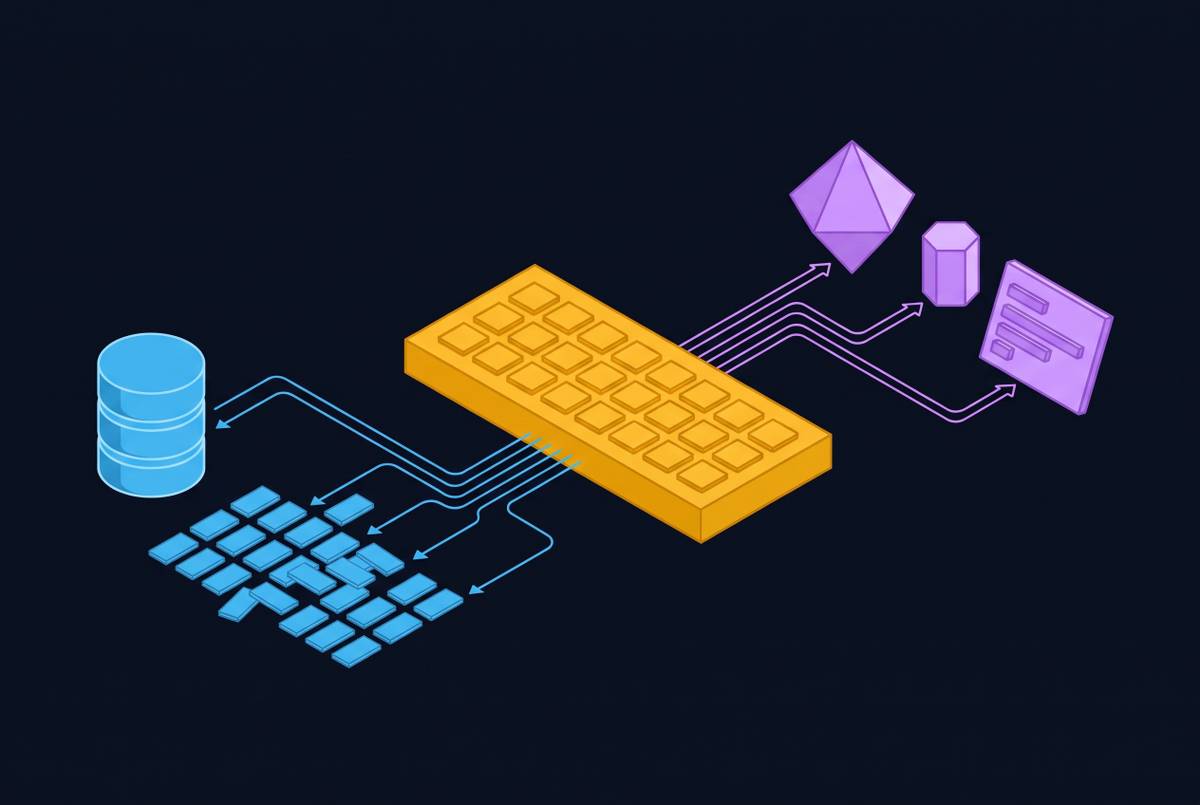
Governed datasets give agents scoped, defined, auditable data access.

For API-first and agent-first teams, a headless analytics backend should expose governed datasets through APIs without requiring an opinionated frontend. Governed datasets, rather than raw database access, give AI agents defined access scope, shared metric meanings, and an audit trail before they construct a query. This separates control over the application interface from permission to explore production tables.
Why a SELECT grant is not a security boundary
A GRANT SELECT on a Postgres role, sometimes paired with a read replica, is a familiar starting point for agent access. The role blocks writes, while the replica separates reads from the primary database. These are real protections, but they are partial. Neither establishes whether an allowed read serves an authorized purpose, respects the requesting user’s scope, or uses the right business definition.
Prompt injection exposes the gap between permission and purpose. An attacker can plant an instruction in data the agent later reads, such as a support ticket, directing it toward executive compensation records. If the agent’s credential permits that read, Postgres sees valid SQL under a valid credential and executes it. The database permission has worked as configured. The failure is that the credential grants a broader reach than the task requires.
Policy inheritance creates a separate risk. Row-level security rules written for human callers do not apply to a shared service credential by default. A regional restriction that blocks a human analyst may never fire for the agent acting on that analyst’s behalf. Read-only access therefore leaves two distinct questions unanswered, namely whose authority governs the request and what the resulting numbers mean.
Why the enforcement point must move before the query is built
The same natural-language question asked twice can produce two different SQL queries. That makes a query whitelist a moving target. Even when both queries are syntactically valid, they may select different populations or calculate different results. Approving one SQL statement does not set a lasting limit on what an agent may learn about the business.
Regex-based filters and application guardrails face the same structural problem because they inspect the query after the agent has constructed it. Common table expressions, writable views, and different ways to get a result make it hard to check generated SQL with pattern matching. This limits what filters can guarantee. Monitoring has a different limitation. By the time anomaly detection flags a problematic read, its results may already have reached the agent.
The architectural consequence is that permissions define the blast radius. An agent inherits the reach of its credentials, so the reliable boundary must constrain the data available to query. The recommended sequence is to steer agents toward governed datasets, bind their access to an explicit list of tables, and start read-only. The platform must enforce those limits before the query is built. A prompt can describe the policy, but it cannot substitute for enforcement.
What a governed dataset actually is, and how it differs from a restricted role
A governed dataset is a pre-modeled object with a defined schema, a specific row population, and explicit metric definitions. It is a separate artifact made for use outside production, with more than tighter grants on a production table. People set the rules for turning production data into that artifact. The agent queries the resulting dataset. This changes both the access target and the context available for interpreting it.
On its own, a column called acct_st says little about what it means for the business. A data product for customer account information, verified daily and owned by Finance, provides meaning, freshness, and ownership in a callable form. The agent no longer has to infer the significance of an abbreviated field from its name alone. It has an object whose intended use is part of its definition.
Nexla’s 2026 guide identifies five properties of agent-ready data, including discoverability, semantic context, governance that survives transformations, freshness SLAs, and a callable runtime interface. Clean tables alone are not enough for this purpose. AI-ready data may serve an ML engineer who supplies the missing context, while agent-ready data exposes that context with the data product itself. A governed semantic layer supports this distinction through named virtual datasets over physical data. Definitions such as MRR, churn, and LTV belong to those datasets.
The three governance properties that a governed dataset enforces before any query runs
Access scope starts with the identity behind the request. Atlan’s 2026 access guide contrasts shared credentials, which expose everything the connection can reach, with governed access limited to what the requesting user is entitled to see. The dataset’s row- and column-level policies establish that scope before the agent chooses how to query it. The boundary belongs to the object across SQL formulations.
This also changes the role of persistent credentials. The same guide flags reliance on long-lived static API keys or personal access tokens in the majority of open-source MCP server implementations. A connection key is not a user-specific policy. With governed access, metadata policy determines authorization, so having a persistent credential is not enough to grant access. Who is making the request still matters after the connection is made.
Semantic correctness puts business meaning into the execution path. The model handles language and reasoning, but it does not invent the company’s definition of revenue. Without that boundary, one caller can use SUM(revenue) while another uses SUM(amount_captured), producing divergent Q2 figures. An agent can then propagate the discrepancy through downstream actions before a person checks it. A stale definition can lead to errors in the work itself as well as a misleading report.
In a medallion-style architecture, the gold layer has governed, business-ready views for callers to use. Agent queries should land there. That placement makes approved definitions part of the query target. Semantic governance still requires maintained definitions and known freshness. A shared calculation is useful only when it represents the business rule that should apply.
Auditability links a result to its governed context. The useful record is that an agent queried dataset version X at time T under identity Y. A generic query log may show the syntax without showing which business meaning was used. Thresholds, approval bands, and escalation rules therefore belong in business configuration rather than prompts or code, so they apply consistently and their application can be demonstrated. These three properties interlock because scope without identity is difficult to prove, while a recorded query without its metric definition is difficult to interpret.
How MCP servers expose governed datasets to agents without opening a raw connection
An MCP server connects an agent to tools and data sources through a standard interface. It can expose governed datasets without giving the agent a raw production connection. The distinction lies beneath the interface, however. MCP standardizes how the request reaches a system, but the protocol itself does not supply the authorization decision. A server that delivers everything an underlying credential can reach remains a conduit for that credential’s privileges.
Atlan’s guide places access policy before the connector. The governed metadata layer defines what the caller may access, and the MCP server exposes data under that policy. This reverses the pattern of connecting first and narrowing access later. The server is a bridge whose usefulness depends on whether the governed layer beneath it enforces the requesting identity’s scope and preserves the dataset’s business context.
For teams adding usage analytics to an AI agent without a prebuilt dashboard, the headless variant provides the relevant pattern. A stateless MCP server exposes governed metrics as a background API, while an autonomous client orchestrates the LLM through scripts, webhooks, or cron. No chat UI is required for that arrangement. The application team controls how the client works, while the governed layer controls who can access the data and how it is defined. The selection criteria for this kind of analytics backend are therefore callable metrics, enforced authorization, and independence from a prescribed frontend.
Why agents querying production Postgres directly also creates a performance problem, not just a security one
Raw agent access creates a performance risk even when a team is satisfied with its permissions. Analytical reads compete with transactional work when both run on the production primary. Agents can intensify that competition by issuing queries continuously. Preventing writes leaves the cost of scans, calculations, and occupied connections untouched.
Supabase grounds database queries, auth requests, and storage access-control checks in its Postgres core. A conventional project centers on a primary Postgres database, where writes converge. Analytical work placed on that primary can therefore degrade transactional performance. Connection limits can become the first constraint. An agent that continuously occupies pooled connections consumes capacity that transactional requests also need, while poor visibility into latency and pool saturation allows degradation to compound quietly.
The practical response is to monitor slow queries, avoid unbounded table scans, paginate large result sets, and move expensive reporting workloads off the primary. Supabase’s guidance recommends replicas, materialized views, or external analytics systems for expensive reporting. A replica can protect the primary without defining what revenue means or which regional records an agent may see.
Governed datasets address both concerns when costly analytical work is done ahead of time and its results are served away from production. The agent requests a prepared metric instead of repeatedly reconstructing it from transactional tables. This reduces the work required at request time. For a team building on Supabase, raw API access to an analytics backend need not mean raw access to its production database. An API can leave the application free to change while serving scoped, pre-calculated data away from the transactional workload.
What "one governed data layer" means in practice for a startup whose agents and humans share the same numbers
A startup does not need one set of definitions for people and another for agents. The same governed dataset can serve both through the interfaces each uses. MRR, churn, and LTV are calculated once, so dashboards and agent workflows draw on the same definitions. A calculation change can then reach every consumer through the shared layer. This avoids parallel infrastructure whose numbers must later be reconciled.
The operating rule is to assign a single owner who has final authority over what a metric such as CAC means. Without that ownership, competing definitions can return despite the access controls around them. The definition belongs in the governed object. That gives the owner a concrete place to resolve disagreements and apply changes.
The same operating model favors calculating metrics ahead of time and pushing them to workplace messaging tools, inboxes, and reporting dashboards. Agents use those prepared definitions through APIs, while people get them where they work. Governance also runs in two directions when agents help govern data while relying on governed data themselves. A shared layer gives both activities a common set of definitions and policies.
Nexla’s guide frames the architectural choice as deciding which layer belongs to the team. The governed data product layer is the part to own deliberately, while vendor connections at the edges and agent frameworks above it can be bought. This leaves the startup in charge of business meaning, access policy, and ownership while keeping it free to choose a frontend. The operating model is one layer, one definition, and one audit trail, with humans and agents using the interfaces their work requires.