Postgres Aggregate Views as the Decoupled Analytics Contract for AI-First Product Teams
Aggregate views give agents governed metrics without exposing production.
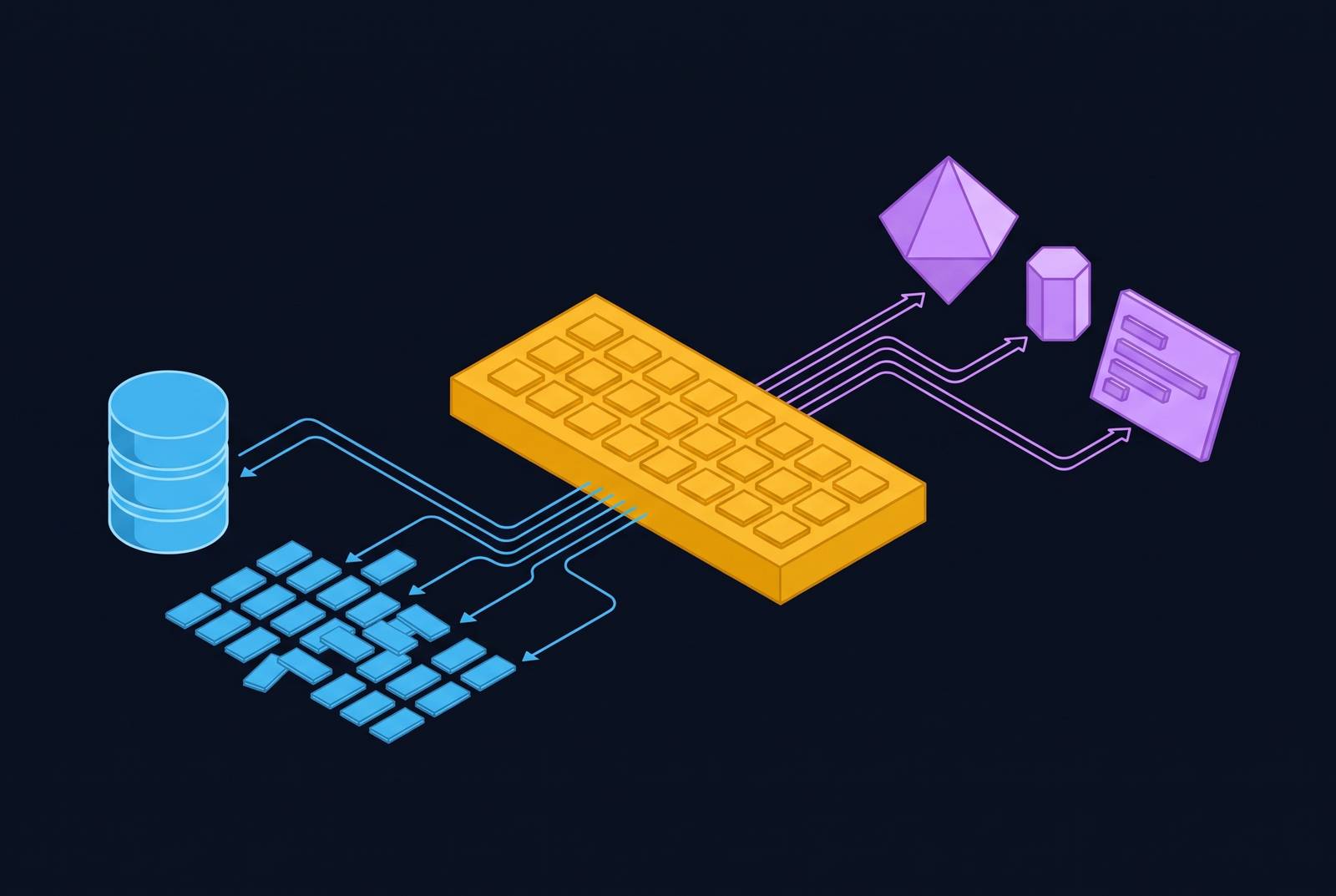
For API-first and agent-first teams that want full API control without an opinionated frontend, the analytics backend should expose governed, pre-modeled datasets. Postgres aggregate views define that contract, while a separate analytical layer delivers it to dashboards and agents. This headless analytics architecture makes metric definitions reproducible, permissions explicit, and analytical demand independent of production query capacity.
Why agents have changed what a production Postgres database needs to do
An agent can generate database demand faster than a human analyst can review it. A single misconfigured agent can exhaust a connection pool in seconds, turning a reporting request into a production availability problem. Agents execute the work implied by a prompt, whether it entails lightweight lookups or full-table aggregations. Unless the architecture separates those workloads, analytical requests land on the same instance that serves the product.
The change also reaches beyond query volume. When several agents share a credential, every agent inherits that credential’s access scope, regardless of its task. A request to summarize usage may thus have permissions to reach far more data than it needs for the answer. The database sees the credential. This creates a structural gap between what an agent can reach and what it should reach, which prompt engineering or alignment training alone cannot close.
Human dashboards did not introduce this combination of runtime query generation, machine-speed repetition, and uncertain intent. Their presence does not establish that a database is ready for agents. Production now needs a boundary that separates operational work from analytical demand and permitted access from available credentials.
What OLTP and OLAP workloads actually want from the same disk
OLTP favors fast, random, row-level reads and writes, while OLAP favors sequential scans, large aggregations, and multi-table joins. These patterns compete for shared buffer space and disk I/O. An analytical query can tie up those resources for seconds while transactional requests need to finish in a short, predictable time. The conflict begins below the query interface. Tuning can change its severity, but it does not remove the competing access patterns.
Connection use makes the conflict immediately visible. A Postgres instance has a fixed max_connections limit, and long-running analytical queries retain connections that transactional requests also need. Adding MCP server instances does not give the database more capacity because each server still needs a connection. An agent loop compounds the pressure. A bug or unexpected input can produce repeated expensive queries until the agent is stopped.
A read replica separates analytical I/O from the primary and is a platform-level answer to this problem. That isolation has a financial cost. In the Supabase setup described here, the replica runs the same compute size as the primary and bills separately, roughly doubling database spend. For early-stage teams, the architectural question is therefore not simply whether Postgres can execute an aggregation, but where that computation belongs and how often it must run.
What a Postgres aggregate view actually is and why "view" undersells it
A regular Postgres view stores a query definition and re-executes it whenever a consumer reads the view. A materialized view stores the computed result on disk and updates it through refreshes. Consumers retrieve an existing result instead of repeatedly performing the work that produced it. Read performance still depends on the result being queried, so materialization is not a universal latency guarantee.
The term aggregate view describes what the result is for, without naming a separate storage mechanism. Its output is a modeled summary, such as revenue by day, active users by cohort, or churn by plan tier. In this architecture, materialized aggregate views store those summaries. The aggregation has already happened before the consumer arrives. An agent reads the chosen grain rather than scanning transactional detail to invent its own grouping.
The read-only interface is equally important to the design. An agent permitted only to read the view cannot use that access to mutate the underlying rows. Refresh timing is another explicit decision. The team determines when the snapshot updates, making freshness a governed property.
How the aggregate view functions as a formal contract between operational data and its consumers
A named aggregate view becomes a contract when its definition fixes the output, freshness, and access boundary. The output has column names, metric definitions, and grain. Freshness identifies when the result was last refreshed and the update schedule consumers can expect. The access boundary specifies permitted readers and excluded data. Together, these terms separate the database’s internal organization from the interface offered to consumers.
One engineer writes SUM(revenue), another writes SUM(amount_captured), and Q2 revenue depends on which query supplies the answer. The disagreement can remain hidden until someone asks for audited numbers. A shared definition removes that particular ambiguity. Dashboards, Slack reports, and agents read the metric encoded in the view.
The contract can also stay the same while operational tables change, as long as the view definition changes in the same version-controlled migration. Consumers need not inherit every internal schema revision. This requires a deliberate limit on the output. Row-level transactional detail, PII, and mutable operational state do not belong in the aggregate contract.
Why agents specifically need a contract surface rather than direct schema access
Direct schema access lets an agent interpret the data at query time. Column names and metadata do not establish the business meaning of a metric, so a plausible query can produce a plausible but incorrect answer. Documentation alone cannot enforce the intended interpretation. A contract removes that negotiation from the request. The agent selects a defined result instead of deciding which tables and fields constitute the metric.
The same distinction applies to authorization. A prompt can ask an agent to stay within scope, but it cannot make a broad database credential narrow. Something outside the model must enforce the permissions. When permissions restrict an agent to an aggregate surface, the accessible output remains bounded even if the agent is manipulated. That protection requires limits on access to the raw tables even when a view is in place.
Reproducibility becomes especially important when agents compose their work. If one agent passes an independently calculated metric to another, disagreement in the underlying definition can propagate through the chain. A shared view fixes the definition at its source. Policy must name the permitted datasets and identities before agents get access. The aggregate view sets the Postgres-native data boundary, and the delivery layer must keep it in place.
What analytics backend gives agents API control without a prebuilt dashboard UI?
A governed analytical layer above Postgres provides the headless surface for this architecture. The view defines the metric, while the layer exposes it without requiring a particular dashboard frontend. These are distinct responsibilities. Even a well-designed materialized view still consumes production connections when read on the primary. A governed analytical copy, such as pre-calculated datasets in governed Parquet queried through DuckDB, moves those consumer queries off the production instance.
MCP supplies the protocol through which agents reach that surface across frameworks and model providers. Agents discover available datasets and request them by name through Resources and Tools. The request targets a declared analytical dataset. Agents can use usage analytics without a prebuilt dashboard or any need for an agent-generated ad-hoc query to reach production. The relevant selection criteria are dataset access, frontend independence, production isolation, and enforceable permissions.
MCP transports requests, but transport is not authorization. A governed server needs fine-grained row- and column-level permissions tied to the identity the agent acts for. Infrastructure should also keep structured, tamper-proof audit records of every agent-data interaction. Those records make provenance verifiable without relying on the agent to report its own behavior.
What the Five Eyes guidance and the pre-action authorization research say about deploying agents without this layer
The Five Eyes joint guidance released in May 2026 by CISA, NSA, ASD, Canada’s CCCS, New Zealand’s NCSC-NZ, and the UK’s NCSC-UK identifies over-permissioned agents as a primary privilege risk. It calls for Zero Trust and least-privilege principles before agents go into production. The trusted identity does not make every action legitimate. Its Confused Deputy Pattern describes an agent manipulated into unauthorized work while operating under its valid identity, which can defeat detection that treats the caller’s identity as sufficient reassurance.
Before the Tool Call: Deterministic Pre-Action Authorization for Autonomous AI Agents characterizes the corresponding enforcement gap as pre-action authorization. The March 2026 paper distinguishes probabilistic model alignment from retrospective evaluation, neither of which supplies deterministic authorization for an individual tool call. Its adversarial testbed makes the distinction concrete. Social engineering worked 74.6% of the time under a permissive policy, while a similar set of attacks had zero percent success under a restrictive declarative policy.
Those results concern the paper’s tested policy enforcement. They support a narrower architectural conclusion. Authorization must constrain the action before execution. Aggregate views and a governed delivery layer implement that principle for analytical data by declaring permitted outputs and preventing access to production schema through the exposed surface.
How founders and early-stage teams should think about locking metric definitions before agents are in the loop
For a founder, the immediate payoff is fewer disputes about the numbers used to make decisions. Early-stage B2B SaaS teams commonly depend on a small set of metrics, including MRR/ARR, CAC, LTV, churn, and gross margin. The minimum viable contract can be small. Its purpose is to make those definitions unambiguous. When sales, finance, and product share an encoded ARR definition, they no longer have to keep meeting to reconcile the numbers.
A definition should lock assumptions as well as names by stating the grain, what it excludes, and how it handles refunds and multi-currency. Otherwise, an apparently stable metric can conceal changing interpretations. This risk grows when automated reports reach investor decks. Assumptions that remain in someone’s head are not available as an enforceable contract to the agent preparing the report.
That discipline extends to changes in the database. Every schema change and affected view definition should enter version-controlled migration history, including changes made through a UI editor. The history makes definition changes traceable. Query observability complements that record, because pg_stat_statements records slow queries and how often they run. Teams can use that evidence to find expensive aggregations to materialize before slowdowns in production force them to act.
The pattern in practice: what a Supabase team actually builds to run this architecture
Before building the analytical layer, a Supabase team should start by partitioning large event tables by date. This reduces the cost of scans that produce the materialized summaries. The next decision is deliberately narrow. The team identifies the five to eight metrics it actually uses for decisions and models each as a named materialized view with explicit grain and a refresh schedule. Other metrics remain candidates for later iterations.
Each view definition belongs in migration history with the schema changes that affect its source tables. Refresh scheduling then becomes an operational choice rather than an incidental side effect of consumer reads. With self-hosted Supabase, the team has full control over that timing. Refreshes can run when traffic is below its peak, before the morning reporting cycle, or after batch imports are done. The schedule establishes the freshness consumers can expect while keeping the cost of recomputation visible.
The team then exposes analytical copies through a governed MCP server. Agents find named datasets under the declared access policy, and their analytical queries stay outside the production connection pool. Human dashboards use the same governed surface. The founder’s weekly report and the agent’s board update then use the same metric definitions and delivery path instead of separate pipelines whose numbers need to be reconciled. The resulting contract fixes what the numbers mean before any consumer asks for them.